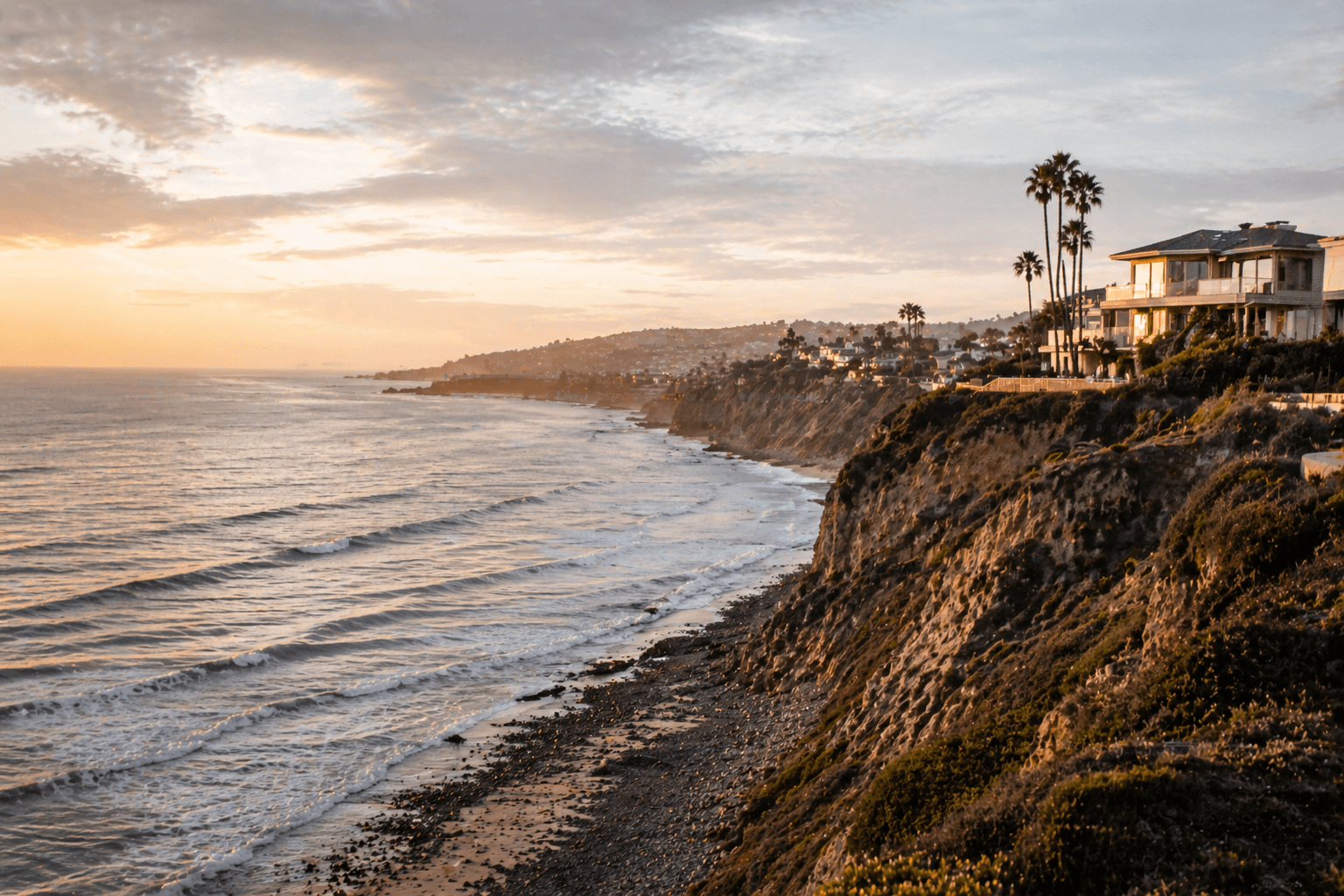
The coastal strip of San Diego County runs about seventy miles, from Imperial Beach at the southern end up to San Onofre at the Orange County line. Most of the people thinking about moving here picture a single thing — a sun-drenched bungalow a few blocks from the sand — and most of them eventually learn that the coast is far less uniform than that picture suggests. The micro-climates change every five miles. The communities change just as fast. What follows is the orientation most people wish they'd had before signing a lease.
The first thing worth understanding is the marine layer. From roughly May through July, the coast spends mornings under a thick gray cloud locals call "May Gray" and "June Gloom." It usually burns off by noon, sometimes by two, occasionally not at all. Inland communities a few miles east — Mira Mesa, Kearny Mesa, parts of Rancho Bernardo — can be in full sun while La Jolla is sweater weather. People who move from out of state for the postcard version of San Diego summer are sometimes surprised to find their first two months feel like Seattle. By August it clears, and September and October are arguably the best weather months in the country.
The second thing is that "coastal" means different things at different latitudes. Imperial Beach and Coronado, at the southern end, are flat, wide-beached, and quieter than their northern counterparts. Point Loma and Ocean Beach are older neighborhoods with more character and more wear; OB still runs counterculture, Point Loma runs more residential. Mission Beach and Pacific Beach are the youngest and loudest stretch of coastline — boardwalks, bars, surf schools, vacation rentals. La Jolla is its own ecosystem entirely: a wealthy, cliff-lined village with sea lions, a serious art scene, and traffic that gets ugly in summer. Bird Rock to the south of La Jolla, and Windansea within it, run quieter and more residential.
North of La Jolla, the character shifts again. Del Mar is small and horse-track-flavored. Solana Beach is steadier, more residential. Cardiff is a surf town with a tight community feel. Encinitas has emerged over the last decade as one of the most coveted coastal communities in California — walkable downtown, strong school district, an unusual concentration of independent restaurants. Carlsbad runs larger and more suburban. Oceanside, once the affordable end of the coast, has changed dramatically; the harbor district and the Mission Avenue corridor are unrecognizable from ten years ago.
The third thing is the cost layered on top of cost. Coastal property carries the obvious premium, but the secondary costs are what catch people. Insurance is more expensive within a mile of the ocean. Salt air corrodes anything metal — appliances, fixtures, car parts — faster than you'd expect. HOA fees in coastal condo buildings can run high, particularly in La Jolla and Coronado, where seismic and ocean-exposure maintenance is a real line item. Mello-Roos taxes still apply in newer Carlsbad and Oceanside developments. Short-term rental rules vary city by city and have been changing year over year, which matters if you're considering a property as part-time rental income.
The fourth thing is traffic, which most newcomers underestimate. The I-5 corridor through North County backs up reliably from 7 to 9 in the morning and 3 to 7 in the afternoon. The 5 through downtown is worse on Padres game nights. Coast Highway 101 is a beautiful drive and a slow one — stop signs, beach traffic, summer tourists. If your job is in Sorrento Valley or UTC and you're living in Encinitas, plan for thirty to forty-five minutes each way. The trolley extension to UTC has helped. It hasn't fixed it.
The fifth thing — and the one most worth absorbing before committing — is that coastal life rewards a specific kind of routine. You wake up earlier because the mornings are the best part of the day. You learn the tides because half the beaches change shape with them. You get used to slightly damp towels, sand in the car, sweatshirts in July. You build a life around proximity to the water rather than around indoor amenities, which is both the appeal and, for some people, the eventual frustration.
The shorthand: the coast is worth it for the people it suits, and the suitability is more about temperament than budget. Spend a few weeks in the specific stretch you're considering before you commit. The differences between Cardiff and Carlsbad, or between PB and Pacific Highlands Ranch, are larger than they look from a map.