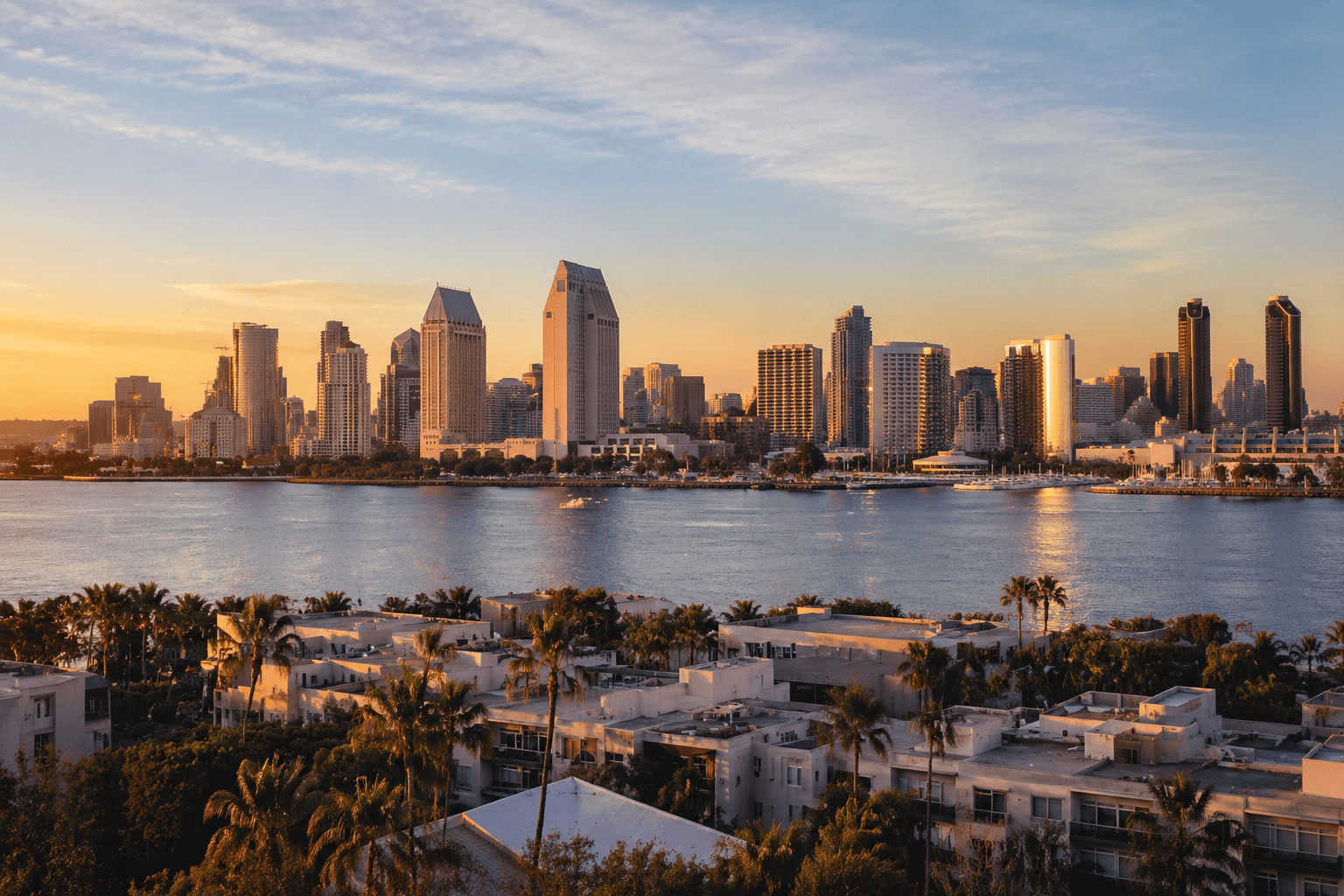
There's a particular kind of morning you only get in Downtown San Diego. The marine layer hangs low over the harbor until about ten, softening the high-rises into something almost European. Joggers loop around the Embarcadero. A container ship inches toward the Tenth Avenue terminal. Someone in workout clothes is already waiting outside the Broken Yolk on Sixth, and the espresso machines at Better Buzz, Communal, and Holsem are all running at full tilt. It's quiet in the way only a coastal city can be quiet — the hum is there, just held back by the fog.
Living here is a study in contrasts, and that's the part most visitors never quite catch. Downtown isn't one neighborhood; it's at least six, stacked into roughly one square mile. The Gaslamp is the loudest of them, a grid of Victorian facades that turns into a street festival most weekends. East Village runs more practical — coffee shops with laptops open, Petco Park looming at the south end, the central library's nine-story dome anchoring the skyline. Little Italy has, somewhat improbably, become the city's strongest food corridor, with India Street running from Civico 1845 down to Born and Raised and the Saturday Mercato that takes over six blocks every weekend. Cortez Hill is hushed and residential. The Marina District feels like a different city entirely, all wide sidewalks and water views. Columbia, tucked between the Santa Fe Depot and the bay, is the part most locals forget exists.
What ties it together is that you can walk all of it. This is the rarest thing about living downtown in a Southern California city: you genuinely don't need a car to get through a normal week. The trolley runs to Old Town and the border. The Coaster connects up to North County. Rideshares are quick. But mostly, you walk. To the farmers' market on Saturday. To the Padres game on a Tuesday in July. To the Rady Shell at Jacobs Park, where the symphony plays outdoors against the bay and you can hear the rigging on the sailboats clinking between movements. To Balboa Park, which is technically uphill but only takes about twenty minutes on foot from most of downtown, and once you're there you have seventeen museums, a Spanish colonial village, and the country's second-largest urban park to wander through.
The food scene rewards curiosity more than reservations. Yes, there are the destination restaurants — Herb & Wood, Juniper & Ivy a quick drive away, Lionfish in the Pendry. But the better move is usually the smaller play. Carnitas' Snack Shack on the harbor for a pulled pork sandwich and a sunset. Puesto for tacos that take Mexican food more seriously than the brunch crowd suggests. Morning Glory in Little Italy if you want to understand why people post pictures of pancakes. Cesarina, a few neighborhoods over but worth the walk for handmade pasta in what feels like someone's actual dining room.
The trade-offs are real, and worth naming. Parking is a project. Construction is constant — there's almost always a crane somewhere. Summer Comic-Con weekend turns the sidewalks into a slow-moving river of costumes and lanyards, and you either lean into it or escape to Coronado for four days. The homelessness crisis is visible here in a way it isn't in the suburbs, and pretending otherwise would be dishonest. Living downtown means living with the full texture of a real city, the parts that work and the parts that don't.
But the rhythm of it is hard to give up once you've adjusted. Sunday mornings on the bay path with the cruise ships in port. The way the light hits the Coronado Bridge around 6 PM in late summer. Catching the second half of a Padres game by walking over after dinner because you have a flex pass and seats open up in the seventh. Running into the same barista, the same dog walker, the same guy who plays saxophone outside the Westfield. It's a city that's small enough to feel known and big enough to keep surprising you.
Downtown San Diego isn't for everyone, and people who try to sell it as universally perfect tend to be selling something. But for the people it suits, the appeal is straightforward: you live in a walkable, ocean-adjacent core of a major city, and most days that fact alone is enough.